
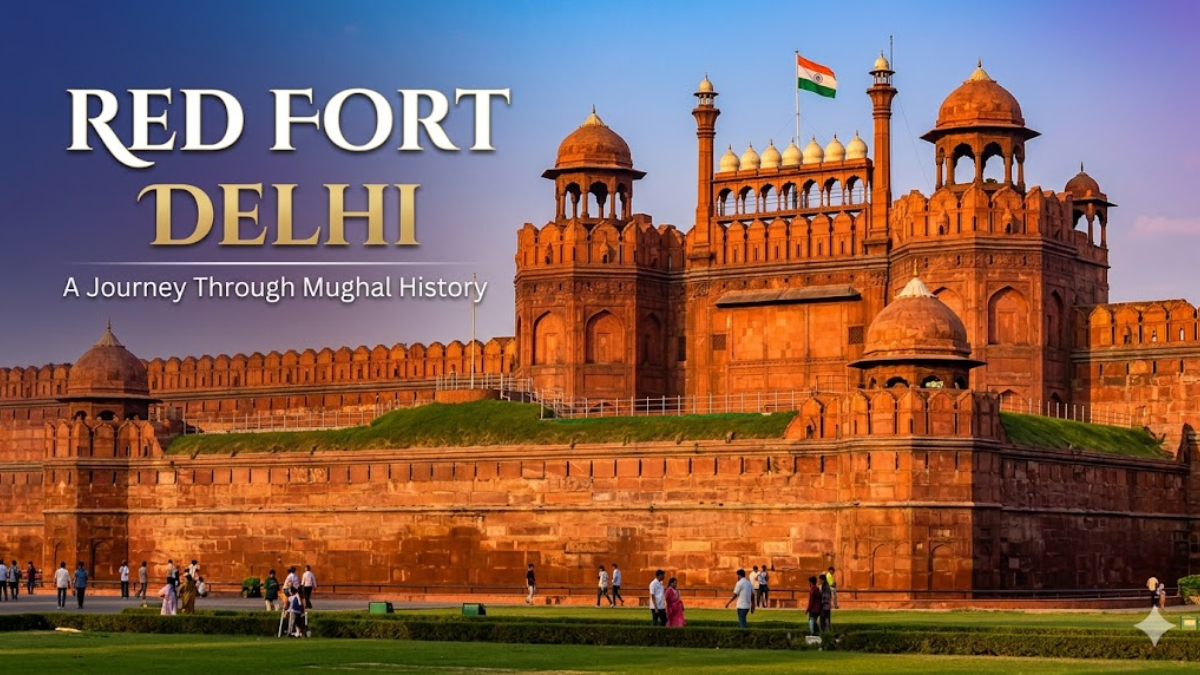
The Red Fort, locally and globally celebrated as Lal Qila, is not merely a monumental fortress crafted from red sandstone; it is the ultimate living manuscript of India’s geopolitical destiny. Standing proudly on the edge of Old Delhi along the historic Netaji Subhash Marg, this sprawling 254-acre imperial citadel is the very site from which the pulse of modern India is articulated every Independence Day, when the Prime Minister unfurls the tricolor from its historic ramparts.
Commissioned in the mid-17th century by the Mughal Emperor Shah Jahan, the Red Fort represents the absolute zenith of Mughal architectural refinement and political authority. For nearly two centuries, it served as the luxurious residential seat of the emperors and the administrative nerve center of a vast empire. In 2007, recognizing its peerless structural influence and historical weight, UNESCO designated the Red Fort as a World Heritage Site.
Whether you are navigating the historic layers of Old Delhi on a rapid same day city tour delhi or indulging in an exhaustive architectural pilgrimage, this comprehensive 2,000-word insider guide provides everything required to decode the secrets, engineering marvels, and practical logistics of this majestic fortress.
Red Fort Essential Visitor Information Hub
To maximize your journey through this massive structural complex without unnecessary delays, it is vital to align your schedule with official ticketing metrics, day segments, and dynamic seasonal shifts.
Detailed Operational Metrics Table
| Operational Parameter | Verified Tourist Guidelines & Details |
| Exact Geographic Location | Netaji Subhash Marg, Opposite Chandni Chowk, Historic Old Delhi, Delhi – 110006, India |
| Day Visit Operating Hours | 9:30 AM to 4:30 PM (The main ticket counters close strictly at 4:00 PM) |
| Weekly Closed Day | Mondays (Strictly Closed) — The monument is inaccessible to tourists for weekly upkeep. |
| Indian Citizens Entry Fee | INR 35 per adult (When booked online) | INR 40 (When purchased via cash counter) |
| SAARC & BIMSTEC Citizens Fee | INR 35 per adult (Applies to visitors from Bangladesh, Nepal, Bhutan, Sri Lanka, etc.) |
| Foreign Nationals Entry Fee | INR 550 per person (Includes access to core manicured courtyards and base museums) |
| Child Entry Allowance | Free Entry for all children below the age of 15 years (Valid ID proof may be requested) |
| Still Photography Charges | Free / Included for standard digital cameras and personal mobile devices. |
| Commercial Video Charges | INR 25 for basic non-commercial video cameras. (Heavy cinematography rigs require prior ASI permit). |
| Audio Guide Devices | Available at the entrance for INR 100–150 in English, Hindi, French, German, and Spanish. |
| Required Exploration Time | 2.5 to 4 Hours minimum to walk the expanses and study the museum exhibits properly. |
Essential Entry Strategy Tips
The Online Advantage: The lines at the physical cash counters outside Lahori Gate can become exceptionally long, especially on weekends and public holidays. To bypass these crowds, it is highly recommended to scan the official Archeological Survey of India (ASI) QR codes stationed at the plaza or purchase your digital tickets in advance through the official government portal. Online tickets also come with a small financial discount.
Security Restrictions: The Red Fort is heavily fortified by paramilitary forces. Visitors must pass through strict metal-detection scanners. Prohibited items include: large backpacks, luggage bags, Swiss knives, scissors, laptops, electronic tablet devices, matchboxes, lighters, and outside heavy food items. Small water bottles and handheld ladies’ purses are perfectly permissible.
History Background: The Relocation of an Empire
To truly look past the red stone facade and understand the soul of Lal Qila, one must trace the historical shifts of the year 1638. At that time, the Mughal Emperor Shah Jahan was ruling from the Agra Fort. However, he found that his capital city was increasingly constrained by urban congestion, cramped military movement, and the natural erosion of the Yamuna River banks.
Seeking to cement his legacy as the greatest builder-king of his lineage, Shah Jahan made a monumental strategic decision: he would move the entire imperial court, the royal treasury, and the military apparatus northwards to the historic plains of Delhi.
The Birth of Shahjahanabad
The Emperor did not merely build a palace; he mapped out a brand-new, fortified capital city named Shahjahanabad (which constitutes what we call Old Delhi today). The magnificent focal point of this walled city was to be the Qila-i-Mubarak (The Blessed Fort), known today as the Red Fort.
The initial foundation stone of the fortress was formally laid on the auspicious day of May 13, 1639. Under the master supervision of the empire’s elite design brains, construction workers, marble sculptors, and stonecutters labored continuously for nearly a decade.
On April 19, 1648, the keys to the completed paradise were delivered to Shah Jahan, who entered the grand Diwan-i-Khas through velvet canopies to take his seat upon the throne for the very first time.
The Turbulent Timeline of Power Shifts
The fortress has stood as a quiet witness to the grand rises and violent collapses of successive Indian regimes:
The Zenith (1648–1707): Under Shah Jahan and his successor Aurangzeb, the fort served as the opulent absolute center of wealth and power in South Asia.
The Persian Plunder (1739): The Persian emperor Nadir Shah breached the defenses of Delhi, systematically massacred thousands of residents, and stripped the Red Fort of its most valuable treasures, including the legendary Peacock Throne and the Koh-i-Noor diamond.
The British Takeover (1857): During the Great Indian Rebellion of 1857, the fort became the symbolic headquarters of the rebel forces surrounding the last titular Mughal Emperor, Bahadur Shah Zafar. Following the fall of Delhi, British forces exiled the king, demolished more than 80% of the internal marble residential pavilions, and replaced them with stark, clinical military barracks.
The Dawn of Freedom (1947): On August 15, 1947, Jawaharlal Nehru, the first Prime Minister of an independent India, ascended the stairs above the Lahori Gate to raise the national flag, permanently transforming the fort from a symbol of colonial subjugation into a timeless monument of national sovereignty.
Architectural Marvel: The Synthesis of Imperial Styles
Architecturally, the Red Fort represents the highest, most complete expression of the Shahjahani style—a sophisticated design language that seamlessly blends the grand features of traditional Rajput temple masonry, the floral geometry of Persian architecture, and the majestic domes of Timurid structural design.
Master Plan and Materials
The layout of the fort was designed by the celebrated architect Ustad Ahmad Lahori (the brilliant mind behind the Taj Mahal). Rather than a standard square configuration, Lahori adopted an asymmetrical octagonal (8-sided) blueprint. This strategic shape allowed the fort to trace the natural, curving bank of the Yamuna River on its eastern side while providing massive defensive frontage towards the city plains on the west.
The principal building blocks of the massive defensive walls are giant blocks of local red sandstone, quarried from the hills of Rajasthan. This stone gave the fort its iconic color and colloquial name.
In striking contrast, the highly private inner palaces were constructed using pure white Makrana marble, inlaid with semi-precious gemstones (a technique known as Pietra Dura or Parchin Kari), gold leafing, and complex mirror glass panels brought from Venice.
Defensive Engineering Specifications
The outer defensive walls of Lal Qila are a true masterpiece of military engineering:
Total Perimeter: The walls wrap around a continuous loop of 2.41 kilometers (1.5 miles).
Varying Heights: The walls rise to a commanding height of 33 meters (108 feet) on the vulnerable city side to repel incoming cannon fire, while dipping down to a secure 18 meters (60 feet) along the natural river boundary.
The Moat System: The entire land-facing perimeter of the fort was historically bordered by a deep, 23-meter-wide defensive moat filled with water and crocodiles to prevent enemy soldiers from setting up siege ladders.
In-Depth Guide to Core Inside Attractions
When you step past the security zones of the Red Fort, you are entering an intricate, highly planned sequence of imperial spaces designed to transition seamlessly from public grandeur to absolute private luxury.
1. Lahori Gate
The Lahori Gate serves as the main public entrance to the Red Fort. It is so named because it sits directly aligned with the historic highway pointing towards the city of Lahore (now in Pakistan).
Framed by two massive octagonal towers and topped by eleven beautiful open-air miniature domes (chhatris), this gate is one of the most culturally significant structures in India. It is from the balconies built directly above this archway that the national flag is raised every 15th of August.
2. Chhatta Chowk (The Vaulted Arcade)
Immediately upon crossing the threshold of the Lahori Gate, you step into the cool shade of the Chhatta Chowk (literally translating to the Covered Market). This structure is highly unique in Islamic architecture; rather than an open-air bazaar, Shah Jahan designed it as a fully enclosed, two-storeyed vaulted arcade featuring 32 arched shopfronts.
During the peak of the Mughal era, this market was an elite, high-end luxury shopping zone. The ground level was lined with international merchants selling rare silks from China, heavy brocades from Persia, priceless carpets from Samarkand, and uncut diamonds from the Golconda mines to the royal court ladies. Today, it houses local vendors selling traditional Indian handicrafts, woodwork souvenirs, and silver jewelry.
3. Naubat Khana (The Drum House)
Positioned at the far end of the covered market stands the Naubat Khana, or the House of Music. This large, two-storeyed brick pavilion served as the formal gateway dividing the public commercial zones from the imperial administrative squares.
Historically, musicians sat in the upper galleries twenty-four hours a day, playing kettledrums, long horns (nafeeri), and cymbals at designated hourly intervals to signal the change of guard or the arrival of the Emperor. All visiting nobles, foreign ambassadors, and princes were legally required to dismount from their elephants or horses at this exact gate; only the Emperor himself was permitted to ride further inside the complex.
4. Diwan-i-Aam (The Hall of Public Audience)
The path from the Drum House leads directly into a massive, wide-open courtyard that culminates in the grand Diwan-i-Aam. This is a large, open-walled ceremonial hall built from red sandstone, supported by an intricate framework of 60 elegant pillars configured into three successive rows of flat-topped arches.
It was here that the Emperor sat in state to handle everyday administration, review military parades, and hear the direct petitions of his ordinary subjects.
The focal highlight of this hall is the Marble Throne Canopy, an elevated alcove built into the back wall. Crafted from pristine white marble, it features beautiful floral mosaics of semi-precious stones and a beautifully carved marble bench where the prime minister (Wazir) sat to hand up documents to the King.
5. Diwan-i-Khas (The Hall of Private Audience)
Moving deeper into the inner riverfront terrace, the red sandstone gives way entirely to white marble at the Diwan-i-Khas. This structure was the absolute inner sanctum of geopolitical power in the 17th century—the place where the Emperor held secret council meetings with his inner cabinet, ministers, and high-ranking foreign envoys.
The hall features a beautiful ceiling that was historically covered in pure sheets of solid silver, which reflected the light of thousands of perfumed candles. Engraved in golden Persian calligraphy along the cornices of the inner walls is the world-famous couplet composed by the court poet Amir Khusrau:
“Gar firdaus bar roo-e zameen ast, Hameen ast o hameen ast o hameen ast.”
(If there is a paradise on earth, it is this, it is this, it is this.)
It was inside the center of this specific marble hall that the Peacock Throne sat before being taken by Nadir Shah in 1739.
6. Rang Mahal & Mumtaz Mahal (The Royal Harem)
Running along the southern flank of the private marble terrace are the Rang Mahal (Palace of Colors) and the Mumtaz Mahal. These beautifully carved buildings served as the primary living quarters for the Emperor’s wives, concubines, and royal maidservants.
Rang Mahal: True to its name, its ceilings were historically covered with intricate gold leaf and thousands of tiny mirror pieces brought from Venice, creating a shimmering, starry effect when lit at night. The center of the palace features a beautiful marble lotus basin through which the fresh waters of the Nahr-e-Bhiwst flowed continuously.
Mumtaz Mahal: Today, this pavilion has been converted into a premium Archaeological Museum, holding an incredible, rich collection of authentic Mughal miniature paintings, old royal jade inkstands, ivory daily objects, and blood-stained swords from the 1857 uprising.
7. Moti Masjid (The Pearl Mosque)
Located immediately to the north of the private residential quarters sits the Moti Masjid, a small, three-domed private mosque built entirely from white and light pink marble.
Unlike the rest of the fort, which was built under Shah Jahan, this structure was added later, in 1659, by his highly religious son and successor, Aurangzeb. The mosque features high outer walls to ensure total privacy, allowing the Emperor to perform his daily prayers in complete isolation from the main court.
The Iconic “Jai Hind” Light & Sound Show
A true highlight of modern tourism at the Red Fort is the newly updated “Jai Hind” Light and Sound Show. This state-of-the-art evening performance transforms the dark sandstone walls of the fort into a giant open-air theater screen using advanced 3D projection mapping technology, immersive surround sound, and live-action light configurations.
The Narrative Journey: The show takes visitors on an emotional, dramatic journey through the history of Delhi, tracing the rise of Shahjahanabad, the plunder of Nadir Shah, the tragic exile of Bahadur Shah Zafar, the trial of the Indian National Army (INA), and the ultimate dawn of Indian Independence.
Language and Timings: The show is conducted daily (except Mondays) in consecutive batches of Hindi and English. The exact timings shift dynamically month-by-month to align perfectly with the natural sunset hours:
Winter Timings (Oct to Mar): Starting around 6:00 PM onwards.
Summer Timings (Apr to Sep): Starting around 7:30 PM onwards.
Strategic Seasonal & Dynamic Travel Metrics
To ensure you capture the absolute best landscape photos and enjoy a comfortable walk across the massive, open-air stone courtyards, your seasonal timing must be chosen carefully.
| Travel Season | Applicable Months | Temperature & Environmental Profile | Insider Travel Tips & Vibe |
| Winter (Peak Season) | October to March | 10°C to 25°C (50°F to 77°F) — Pleasantly cool, clear blue skies, morning winter fog. | Highly Recommended. The perfect time for walking the open plazas comfortably. Arrive early at 9:30 AM to beat the mid-day school tour crowds. |
| Summer (Avoid) | April to June | 35°C to 45°C (95°F to 113°F) — Extreme blistering heat, direct intense sun, dry winds. | Not Recommended. The unshaded sandstone paths radiate immense heat. If visiting, carry a wide umbrella, sunglasses, and high-potency hydration fluids. |
| Monsoon | July to September | 28°C to 35°C (82°F to 95°F) — High relative humidity, sudden heavy downpours. | Scenic but Humid. The manicured gardens turn an incredibly vibrant green, making for great photos, though walking through rain showers can be messy. |
Seamless Connectivity: How to Reach Red Fort
The Red Fort is located right at the core hub of Old Delhi’s transportation network, making it exceptionally easy to reach from any corner of the National Capital Region (NCR).
By Metro (The Most Reliable Route): The absolute best way to travel to the fort without getting stuck in Old Delhi’s infamous traffic gridlock is via the Delhi Metro network.
Red Fort Metro Station: Located on the Violet Line, this dedicated station features exit gates that place you directly onto the pedestrian entry plaza of the fort.
Chandni Chowk Metro Station: Located on the Yellow Line, this station is a short 10-minute walk or a quick cycle-rickshaw ride away from the main entrance.
By Auto-Rickshaw & App Cab: You can easily book app-based rides (such as Uber or Ola) from anywhere in Delhi. Request the driver to drop you off at the designated passenger drop-off zone near the Netaji Subhash Marg roundabout.
Historiy Landmarks to Visit Around the Red Fort
Because Lal Qila anchors the eastern edge of old Shahjahanabad, a visit here places you right next to some of India’s most legendary historical and cultural culinary destinations:
Jama Masjid (10-min walk): Located directly opposite the fort across the open plains. Built by Shah Jahan, this is one of India’s largest and most majestic mosques, featuring towering minarets that offer a breathtaking view of the old city.
Chandni Chowk Bazaar (2-min walk): One of the oldest, busiest, and most vibrant shopping marketplaces in Asia, neatly organized into dedicated sub-lanes selling silver jewelry, wedding attire, and electronics.
Paranthe Wali Gali (5-min rickshaw ride): A legendary, world-famous narrow culinary lane inside Chandni Chowk, operating since the 1870s. It serves unique, deep-fried traditional flatbreads stuffed with everything from cashews and cottage cheese to bitter gourd and bananas.
Raj Ghat (7-min drive south): A beautiful, peaceful, and quietly manicured park landscape located along the Ring Road, housing the black marble memorial spot dedicated to Mahatma Gandhi.
Frequently Asked Questions About Red Fort
Is the Red Fort open to the public every day of the week?
No, the Red Fort is strictly closed to the public every Monday for archaeological preservation, chemical cleaning of the stone, and landscape maintenance. It remains open from Tuesday through Sunday.
Can we buy physical entry tickets directly at the fort entrance?
Yes, there are dedicated physical ticket counters located near the main parking entrance. However, the queues can be exceptionally long. Buying an online ticket via the official ASI portal is faster and cheaper.
Is wheelchair assistance available for senior citizens or differently-abled travelers?
Yes, the primary pathways connecting Lahori Gate to Chhatta Chowk, Diwan-i-Aam, and the inner marble terrace are flat and designed to be completely wheelchair-accessible. Ramps are integrated into the main pavilion stairs.
Why is it called the Red Fort if some palaces inside are completely white?
The fort earns its name from its massive, 2.4-kilometer perimeter defensive wall, which is constructed entirely from deep red sandstone. The white marble was reserved exclusively for the private, interior residential palaces of the Emperor and his family.
Are we allowed to step inside the actual throne room inside Diwan-i-Aam?
To preserve the ancient Pietra Dura gemstone inlay work and protect the structural security of the 380-year-old marble throne canopy, visitors must view the throne from behind a low, protective metal barrier on the main floor.
Conclusion: The Living Symbol of a Nation
From its carefully planned octagonal geometry to the finest floral patterns carved into its white marble arches, the Red Fort is far more than an architectural relic of a bygone era. It is a living, breathing testament to India’s complex historical timeline.
Walking through its grand gates is a journey through centuries of absolute royal luxury, devastating foreign plunders, colonial struggles, and the ultimate triumph of independence. For any traveler looking to understand the cultural and political core of India, an afternoon spent exploring the majestic courtyards of Lal Qila is an absolute necessity.

Comment (0)