
Beyond the Taj: A Journey Through India’s Royal Heritage and Untamed Wilds
India is a land where every sunrise brings a new story. For travelers who wish to witness the pinnacle of human architecture alongside the raw power of nature, there is no circuit more iconic than the one connecting the national capital, the city of love, the pink city, and the tiger’s territory. This specifically curated 4-Day Golden Triangle Tour & Ranthambore Safari is designed to immerse you in the diverse soul of Northern India within a compact timeframe.
Chapter 1: The Grand Beginning in Delhi
Your expedition starts in Delhi, a city that serves as a living museum of India’s history. From the narrow, bustling lanes of Chandni Chowk to the wide, leafy avenues of New Delhi, the city offers a sensory overload that sets the stage for the days to come.
The Mughal Legacy in Old Delhi
The first stop for any history enthusiast is the Red Fort. Built by Emperor Shah Jahan, this massive sandstone structure was the seat of power for the Mughal Empire for nearly 200 years. Just across the road lies Jama Masjid, one of the largest mosques in India. Standing in its courtyard, you can feel the spiritual pulse of the city. A rickshaw ride through the adjacent markets is essential to experience the chaotic energy that defines the heart of Old Delhi.
The Architectural Transition to New Delhi
As you move toward the south, the architecture shifts from Mughal to British Colonial. The India Gate, a war memorial standing 42 meters high, is a poignant reminder of sacrifice. Nearby, the Rashtrapati Bhavan (President’s House) and Parliament House showcase the grandeur of the British Raj. The final highlight of the Delhi leg is the Qutub Minar, a UNESCO World Heritage site and the tallest brick minaret in the world, surrounded by ruins that date back to the 12th century.
Chapter 2: Agra – The City of Eternal Love
After absorbing the energy of Delhi, the journey moves toward Agra. The drive via the Yamuna Expressway is smooth, allowing you to reach the city of the Taj Mahal in just a few hours.
The Sunrise Over the Taj Mahal
There is a reason why the Taj Mahal is one of the Seven Wonders of the World. To see it at sunrise is to see it in its most ethereal form. As the first rays of light touch the white Makrana marble, the monument changes colors—from a soft grey to a pale pink and finally to a brilliant, sparkling white. It is not just a building; it is a poem carved in stone, dedicated to the memory of Mumtaz Mahal by her grieving husband, Shah Jahan.
Exploring the Agra Fort
While the Taj Mahal is the star of the show, the Agra Fort is equally impressive. This fortress-palace was the primary residence of the Mughals before the capital shifted to Delhi. Exploring its Diwan-i-Aam (Hall of Public Audience) and Diwan-i-Khas (Hall of Private Audience) gives you a glimpse into the lifestyle of the emperors. Interestingly, it was here that Shah Jahan spent his final years, imprisoned by his son, gazing at the Taj Mahal from a marble balcony.
Chapter 3: The Call of the Wild in Ranthambore
Leaving the marble wonders of Agra behind, the terrain begins to change as you enter Rajasthan. The dry deciduous forests of Ranthambore National Park await.
The Tiger’s Territory
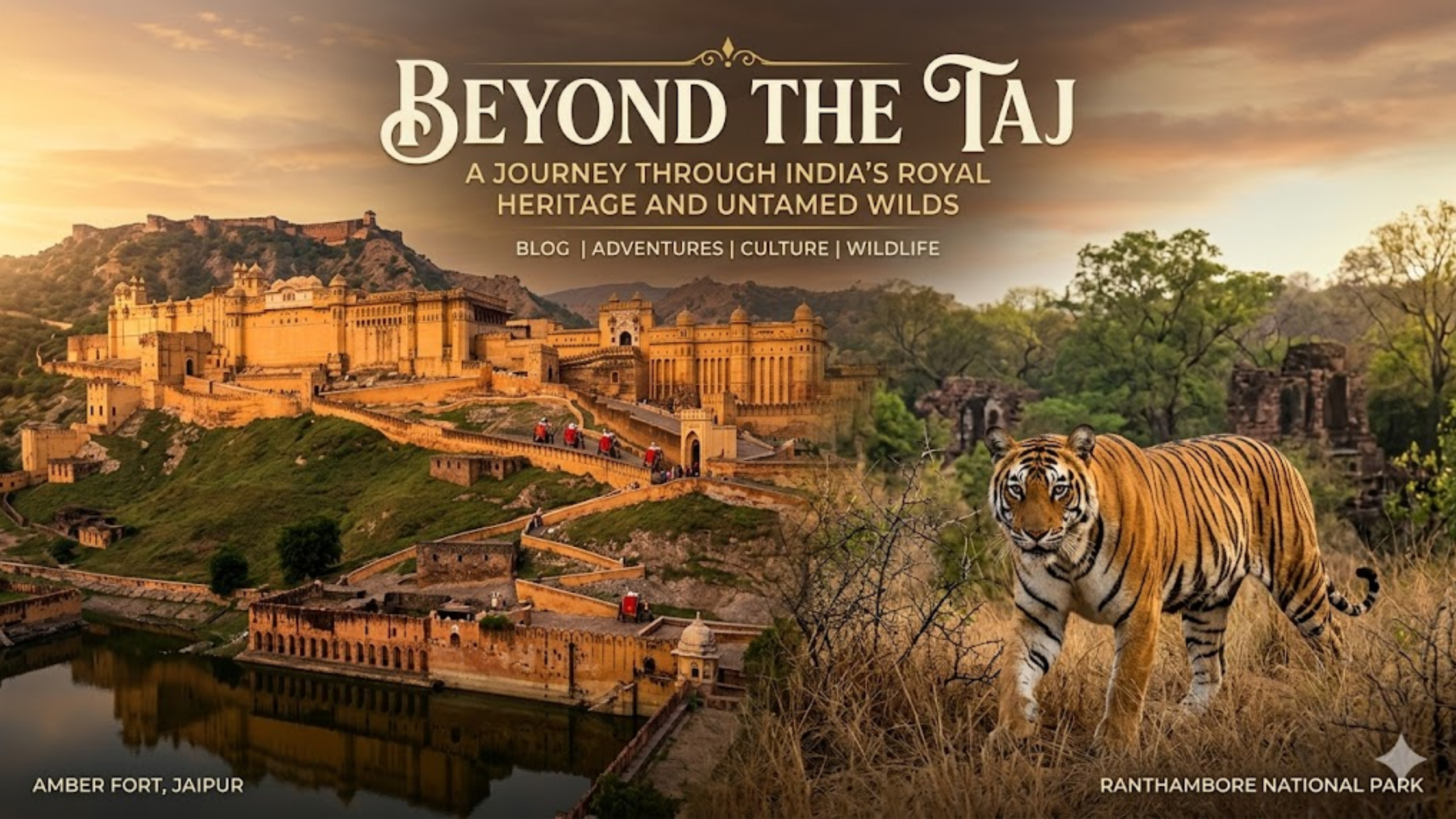
Ranthambore is globally famous for being one of the best places to spot the Royal Bengal Tiger in the wild. But the park is about more than just the big cat. It is a unique ecosystem where ancient ruins and nature have merged. The Ranthambore Fort, which stands atop a hill inside the park, provides a dramatic backdrop to the wildlife experience.
The Safari Experience
A typical morning safari begins before dawn. As the jeep (or canter) enters the forest, the air is crisp, and the “jungle telegraph” begins—the alarm calls of spotted deer and monkeys often signal the movement of a predator nearby. Beyond tigers, the park is home to leopards, sloth bears, striped hyenas, and marsh crocodiles. For birdwatchers, the lakes within the park attract thousands of migratory and resident birds, making it a multifaceted paradise for nature lovers.
Chapter 4: Jaipur – The Regal Pink City
The final leg of the journey takes you to Jaipur, the capital of Rajasthan. Known as the Pink City, it was painted in this hue in 1876 to welcome the Prince of Wales, and the tradition has been maintained ever since.
The Majesty of Amber Fort
Located on a hilltop in Amer, this fort is a stunning blend of Hindu and Mughal architecture. The Sheesh Mahal (Mirror Palace) inside the fort is a highlight, where a single candle can illuminate the entire room through thousands of tiny mirrors. The panoramic views of the Maota Lake from the fort walls are breathtaking.
The Scientific Marvels and Royal Palaces
In the heart of the city lies the Jantar Mantar, an astronomical observatory built by Maharaja Jai Singh II. It features the world’s largest stone sundial and is a UNESCO World Heritage site. A short distance away is the Hawa Mahal, or Palace of Winds. Its unique five-story exterior resembles a honeycomb, with 953 small windows designed to allow royal ladies to observe street festivals without being seen from the outside.
Strategic Travel Tips for the Region
Packing Essentials: Northern India experiences extreme weather. If you are traveling between November and February, carry heavy woolens for early morning safaris. For summer trips (March to June), lightweight cotton and plenty of sunscreen are mandatory.
Photography Gear: For the monuments, a wide-angle lens is best. For Ranthambore, you will need a telephoto lens (at least 300mm) to capture wildlife from a distance.
Booking Safaris: Ranthambore safaris are in high demand and should be booked at least 90 days in advance to secure the best zones (Zones 1 to 5 are generally considered the core areas).
Cultural Etiquette: While visiting religious sites like Jama Masjid, ensure your shoulders and knees are covered. It is customary to remove shoes before entering any temple or mosque.
Frequently Asked Questions (FAQs)
Q1: Is it possible to see everything in just four days?
Yes, but it requires a very structured itinerary. By using the expressways and focusing on the primary landmarks in each city, you can experience the highlights without feeling overly rushed.
Q2: What is the best month to plan this trip?
The months of October, November, February, and March are ideal. December and January are also great, though the mornings can be very foggy and cold. Ranthambore is closed during the monsoon (July-September).
Q3: Can we choose between a Jeep and a Canter for the safari?
Yes. A Jeep is a 6-seater open vehicle that is faster and more private, while a Canter is a 20-seater bus. Jeeps are generally preferred for photography and comfort.
Q4: How far is Ranthambore from Agra?
The drive takes approximately 5 to 6 hours. Many travelers choose to stop at Fatehpur Sikri, the abandoned Mughal city, which is located on the way.
Q5: Is the food safe for international travelers?
Most reputable tour operators use 4-star and 5-star hotels where the food is prepared to international hygiene standards. It is always recommended to drink bottled mineral water.
Conclusion: A Legacy of Stone and Spirit
This journey is more than just a vacation; it is a transition through time. From the power corridors of Delhi to the romantic shadows of the Taj Mahal, from the wild heart of the Indian jungle to the regal courtyards of Jaipur, this circuit captures the essence of India. It is a trip that challenges your senses and rewards you with memories that last a lifetime. Whether you are a solo adventurer, a couple on a honeymoon, or a family seeking a cultural education, the treasures of North India are waiting to be discovered.

Comment (0)