
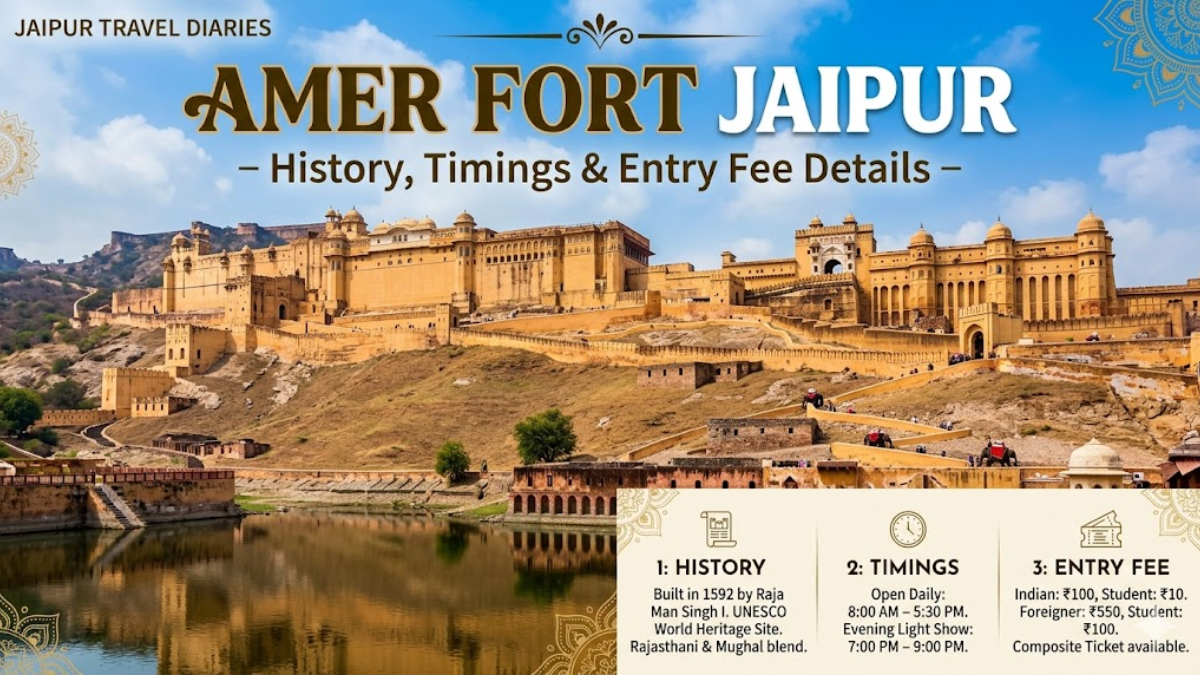
Perched majestically atop the rugged crags of the Aravalli Range, the iconic Amer Palace stands as a breathtaking testament to the military genius, artistic opulence, and architectural brilliance of the Kachwaha Rajput rulers. Located roughly 11 kilometers north of the central Pink City, this UNESCO World Heritage Site rises above the calm waters of Maota Lake, which perfectly mirrors its high sandstone ramparts.
More than just a defensive military stronghold, Amer (often spelled Amber) was a luxurious, sprawling royal palace complex that served as the primary seat of power before Maharaja Sawai Jai Singh II shifted the capital down to the plains of Jaipur in 1727. For any traveler choosing a comprehensive Jaipur city tour package to experience the true grandeur of Rajasthan’s royal heritage, exploring this fortress is an absolute must.
The Golden History of Amer Fort
The historical lineage of Amer dates back to the 10th century, when the Meenas were the original rulers of the region. They dedicated the settlement to Amba Mata, the goddess of earth and fertility, from whom the name ‘Amer’ is derived. In the late 11th century, the Kachwaha Rajputs conquered the region, and it became their principal capital.
The grand palace complex we see today was initiated by Raja Man Singh I in the year 1592. Man Singh was one of the most trusted military generals (Navratnas) of the Mughal Emperor Akbar. Because of his close diplomatic and military ties with the Mughal court, the structural blueprint of the fort heavily integrates elegant Mughal marble work, geometric layouts, and floral fresco paintings with rugged, traditional Rajput fort design rules.
The fort was later expanded and beautifully modified by his direct descendants, Mirza Raja Jai Singh I and Maharaja Sawai Jai Singh II, over the next 130 years until the valley city of Jaipur was officially established.
Complete Structural Layout: The Four Courtyards
The interior of the palace is laid out across four distinct tiers, each featuring its own grand courtyard, monumental entry gate, and dedicated purpose.
First Courtyard: Jaleb Chowk & Shila Devi Temple
This is the massive primary courtyard where visitors enter after ascending the hill. Historically, this space was used by the royal army to display war spoils and hold victory parades upon returning from military campaigns.
Suraj Pol & Chand Pol: The courtyard is accessed via two main gates. The Suraj Pol (Sun Gate) faces east and was used exclusively by the royal family, while the Chand Pol (Moon Gate) was the entry point for commoners and guards.
Shila Devi Temple: Located in a corner of this courtyard, this temple is dedicated to Goddess Durga. The historic black stone idol was recovered from the sea by Raja Man Singh I after his military victory in Jessore (now Bangladesh). Its massive entrance doors are covered in heavy, intricately carved silver sheets.
Second Courtyard: Diwan-e-Aam (Hall of Public Audience)
A wide, elevated platform houses the grand Diwan-e-Aam, the public court where the Maharaja sat to hear grievances, receive petitions, and address the common citizens of his kingdom.
The Fusion Pillars: The hall features a double row of 36 majestic pillars. The outer pillars are carved from rugged red sandstone, while the inner pillars are sculpted from smooth white marble. The tops of these pillars feature bracket carvings shaped like elephants, beautifully blending classic Rajput structural themes with elegant Mughal design elements.
Third Courtyard: Ganesh Pol & The Royal Apartments
This zone represents the transition into the private living quarters of the royal family. It is accessed through the magnificent Ganesh Pol, an entry gate decorated with beautiful frescoes, intricate mosaic tilework, and a central painting of Lord Ganesha.
Sheesh Mahal (The Mirror Palace): This is undoubtedly the jewel of the fort. The walls and ceilings are covered in thousands of tiny, convex mirror mosaics imported from Belgium, arranged in floral patterns. A single candle lit inside this dark chamber reflects across the ceiling, creating the visual effect of a brilliant, star-filled night sky.
Sukh Niwas (The Hall of Pleasure): Situated directly opposite the Sheesh Mahal, this private apartment features an ingenious, early form of natural air conditioning. Water was piped through a channel carved into the marble floor, cooling the mountain breeze as it blew over the water cascade and through perforated sandalwood doors.
Fourth Courtyard: The Zenana (Women’s Quarters)
The innermost, highly secluded courtyard was the residence of the royal queens, concubines, and queen mothers.
The Maze Architecture: Designed with a focus on absolute privacy and security, the Zenana Deodhi features dozens of independent rooms connected by narrow, winding corridors. The layout was planned so that the Maharaja could visit any of his queens’ private chambers without the other wives knowing or seeing his movements.
The Secret Tunnels to Jaigarh Fort
Beneath the elegant palace structures lies a complex network of underground defensive tunnels. The most famous is a fortified, 2-kilometer-long subterranean passageway that connects Amer Palace directly to the formidable Jaigarh Fort perched on the ridge above (Cheel ka Teela).
This tunnel was built as a strategic escape route. In the event of a long military siege or a breach of Amer’s lower walls, the royal family and women could retreat safely uphill to the heavily armed, unconquerable structures of Jaigarh Fort. Portions of this tunnel have been safely restored and are open for tourists to walk through.
Amer Fort Open Timings
To plan your visit properly, make sure to note the daily operational windows for both daytime exploration and night tourism:
Daytime Tourism Hours: 8:00 AM to 5:30 PM (Open all days of the week)
Evening Night Tourism Hours: 7:00 PM to 10:00 PM
Light and Sound Show (English Shift): 7:30 PM onwards
Light and Sound Show (Hindi Shift): 8:30 PM onwards
Entry Fee Details
The entry fee architecture for entering the main palace corridors is divided based on nationality and student status.
Standard Ticket Rates:
Indian National Visitors: ₹100 per person
Indian Students (With Valid ID): ₹20 per person
Foreign National Visitors: ₹500 per person
Foreign Students (With Valid ID): ₹150 per person
Add-On Experience Tariffs:
Evening Light & Sound Show: ₹200 (English) / ₹100 (Hindi) per person
Traditional Royal Elephant Ride: ₹1,100 per couple (Two passengers per elephant, morning shifts only)
Local Authorized Tour Guide Fee: ₹450 to ₹600 for a standard 90-minute walk
Essential Visitor Logistics Grid
| Activity Mode | Best Visit Window | Wheelchair Accessible? | Estimated Duration |
| Morning Palace Tour | 8:30 AM – 11:00 AM | Partially (Ramps in Courtyard 1 & 2) | 2.5 Hours |
| Elephant Ride Climb | 7:30 AM – 10:30 AM | No | 20 Minutes |
| Subterranean Tunnel Walk | 12:00 PM – 3:00 PM | No (Steep Stone Incline) | 30 Minutes |
| Night Illuminations | 7:30 PM – 9:30 PM | Yes (Courtyard access only) | 1.5 Hours |
Frequently Asked Questions (FAQ)
1. What is the best way to ascend to the main entrance of Amer Fort?
Visitors have three main options to reach the top: you can take a traditional morning elephant ride up the stone ramparts, hire a local open-top 4×4 tourist jeep from the base parking lot, or walk up the wide, winding cobblestone pathway on foot, which takes about 15 to 20 minutes.
2. What is the historical difference between Amer Fort and Jaigarh Fort?
While they are connected and part of the same defensive system, they serve different purposes. Amer Fort was built as a luxury residential palace featuring delicate artwork, gardens, and royal courts. Jaigarh Fort, situated higher up the hill, was a strict military garrison housing the royal treasury, armor factories, and Jaivana—the world’s largest cannon on wheels.
3. Is Amer Fort open at night, and is it worth visiting then?
Yes, the fort is open for evening “Night Tourism” from 7:00 PM to 10:00 PM. Visiting at night is highly recommended because the entire sandstone structure is illuminated by warm floodlights, the crowds are much smaller, and the temperature is cooler. However, note that the inner chambers of the Sheesh Mahal are best viewed using daytime natural light.
4. How much time should I set aside in my itinerary to tour the entire fort?
Because the palace complex is massive and spread across four large levels, it takes at least 2 to 3 hours to thoroughly explore all the courtyards, temples, tunnels, and photography points. If you plan to watch the evening Light & Sound show, add an extra hour to your schedule.
5. Is the fort accessible for elderly travelers or visitors using wheelchairs?
Due to its hilltop position and heritage design, the fort has many uneven cobblestone paths, steep inclines, and narrow stone staircases. However, wheelchair ramps have been added to connect the first courtyard (Jaleb Chowk) to the Diwan-e-Aam. For those with limited mobility, hiring a jeep to drive directly up to the back gates is the most comfortable option.
6. What is the significance of Maota Lake, located at the base of the fort?
Maota Lake was constructed to serve two key purposes: it acted as the primary water storage reservoir for the entire fort community, and it formed a crucial first line of defense against enemy forces attacking from the valley. The lake also houses the Kesar Kyari (Saffron Garden), a beautiful terraced garden island designed to grow saffron plants for the royal court.
7. Can we hire official tour guides at the entrance, and what do they cost?
Yes, government-authorized multilingual guides and digital audio guides are easily available near the main ticketing windows. A licensed human guide generally charges between ₹450 to ₹600 for a 90-minute tour. Always make sure to check their official ID card issued by the Department of Tourism before starting your tour.
Conclusion
A complete reading of the Amer Fort Jaipur – History, Timings & Entry Fee Details highlights why this majestic hilltop citadel remains a premier jewel of global tourism. From the grand open courtyards that once echoed with military marches to the breathtaking, delicate mirror mosaics of the Sheesh Mahal, every corner of this historic palace tells a story of royal power and artistic achievement. By keeping track of seasonal timing changes, choosing authorized local guides, and leaving enough time to explore the hidden mountain passages, your visit to Amer Fort will be an unforgettable journey back into India’s vibrant history.

Comment (0)