
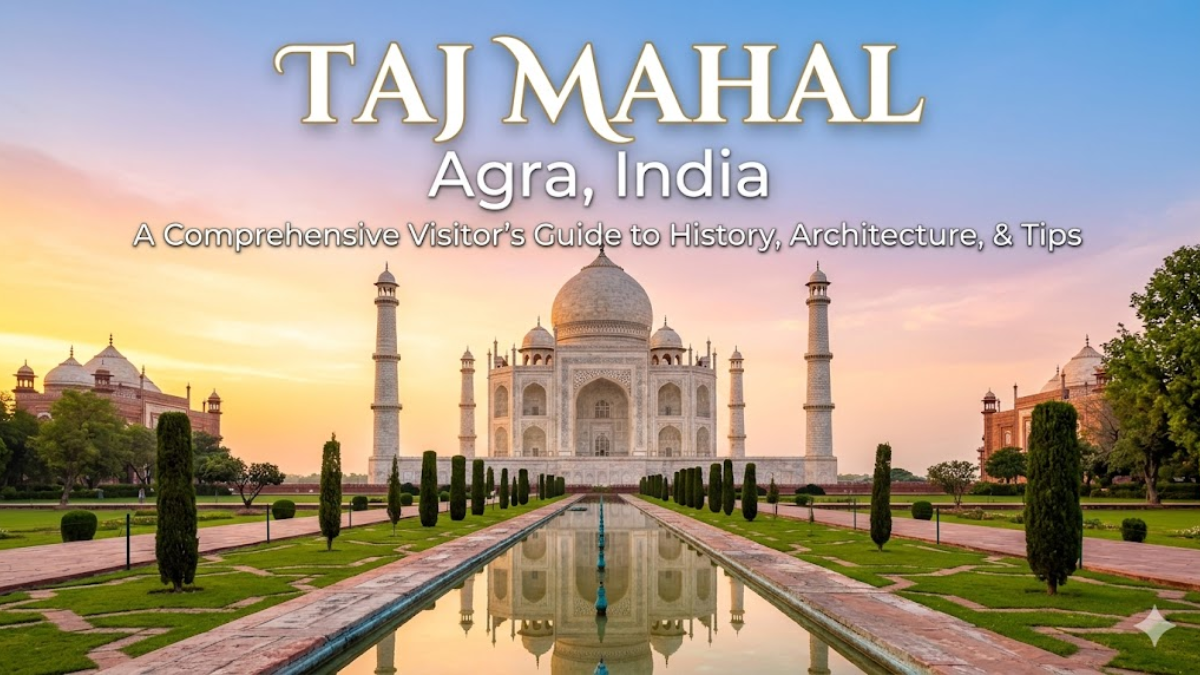
The Taj Mahal, universally acclaimed as the ultimate monument to eternal love, is an unparalleled masterpiece of architectural symmetry and structural beauty. Standing majestically on the southern bank of the Yamuna River in Agra, Uttar Pradesh, this ivory-white marble mausoleum is arguably the most famous building in the world. It is not just India’s crowning cultural jewel; it is a globally recognized UNESCO World Heritage Site and one of the official New Seven Wonders of the World.
Commissioned in 1631 by the fifth Mughal Emperor, Shah Jahan, to house the tomb of his favorite wife, Mumtaz Mahal, the Taj Mahal is the ultimate expression of grief, romance, and artistic perfection. Every year, millions of travelers, historians, and photographers journey to Agra to witness its changing colors—from a soft pink at dawn to a brilliant white under the midday sun and a shimmering gold under the moonlight.
Whether you are capturing stunning travel memories on a quick same day city tour delhi extension down the Yamuna Expressway or taking a detailed, multi-day cultural exploration of the Golden Triangle, this comprehensive guide provides everything required to decode the secrets, engineering marvels, and practical logistics of this majestic wonder.
Taj Mahal Essential Visitor Information Hub
To maximize your journey through this grand monument without unnecessary delays, it is vital to align your schedule with official ticketing metrics, security guidelines, and seasonal operating hours.
Detailed Operational Metrics Table
| Operational Parameter | Verified Tourist Guidelines & Details |
| Exact Geographic Location | Dharmapuri, Forest Colony, Tajganj, Agra, Uttar Pradesh – 282001, India |
| Daily Operating Hours | Opens 30 minutes before Sunrise and closes 30 minutes after Sunset. |
| Weekly Closed Day | Fridays (Strictly Closed) — The monument is open only to local Muslims for afternoon prayers. |
| Indian Citizens Entry Fee | INR 50 per person | Optional internal main mausoleum chamber access costs an additional INR 200. |
| SAARC & BIMSTEC Citizens Fee | INR 540 per person | Optional internal main mausoleum chamber access costs an additional INR 200. |
| Foreign Nationals Entry Fee | INR 1,100 per person | Optional internal main mausoleum chamber access costs an additional INR 200. |
| Child Entry Allowance | Free Entry for all children below the age of 15 years (Valid ID proof may be requested). |
| Night Viewing Tickets | Allowed on full moon nights, plus two days before and after (except Fridays). Limited tickets apply. |
| Required Exploration Time | 2 to 3 Hours minimum to walk the gardens, view the riverfront, and explore the interiors. |
Essential Entry Strategy Tips
Book Tickets Online: Physical ticket windows at the Western and Eastern gates are often crowded. To skip the wait, you can buy digital tickets in advance via the official Archaeological Survey of India (ASI) booking website or scan the official government QR codes outside the monument entrances.
Security Restrictions: Security at the Taj Mahal is exceptionally tight. Prohibited items include: large backpacks, tripods, drones, external flash photography equipment, laptops, mobile chargers/power banks, knives, lighters, matchboxes, tobacco items, and outside food.
Included Amenities for Foreigners: When purchasing a Foreign National ticket, you will receive a complimentary bottle of mineral water, shoe covers (required to walk up onto the white marble platform), and a map of Agra.
Historical Background: An Imperial Love Story
The history of the Taj Mahal is rooted in a profound imperial romance. In 1612, Prince Khurram (who would later ascend the throne as Emperor Shah Jahan) married Arjumand Banu Begum, an exceptionally beautiful and intelligent Persian noblewoman. Deeply in love, Shah Jahan bestowed upon her the title of Mumtaz Mahal, meaning “The Chosen One of the Palace.”
For nearly two decades, Mumtaz Mahal was the Emperor’s inseparable companion, even traveling with him on distant military expeditions. Tragically, in 1631, while giving birth to their 14th child in Burhanpur, Mumtaz Mahal passed away due to childbirth complications.
Overwhelmed by grief, Shah Jahan reportedly went into deep isolation for months. When he emerged, his hair had turned completely white. He vowed to fulfill her final wish: to construct a grand mausoleum that the world had never seen before—a structure that would mirror the beauty of paradise on earth.
Construction formally began in 1632. It took an army of over 20,000 master artisans, stonecutters, calligraphers, and dome builders from Persia, Turkey, and across India, along with a fleet of over 1,000 elephants, to complete the complex. The main tomb structure was finished around 1643, while the surrounding courtyards, gardens, mosque, and guesthouse were finalized in 1654, marking 22 years of continuous, masterful work.
Architectural Marvel: Perfect Symmetry and Spatial Illusion
Architecturally, the Taj Mahal represents the pinnacle of Mughal Architecture, a style that unified Persian, Islamic, and traditional Indian design languages into a single, cohesive form. The monument is designed with absolute, flawless bilateral symmetry; if you draw a line straight down the center of the complex, the left side is a perfect mirror image of the right.
The Optical Illusion of the Minarets
The main white marble tomb is framed at its four corners by four towering minarets, each standing over 40 meters (130 feet) tall. To the casual observer, these minarets look completely vertical.
However, they were deliberately engineered to lean slightly outward. This brilliant design choice serves two distinct purposes:
Optical Correction: It creates a visual illusion that makes the towers look perfectly straight from a distance, preventing them from appearing as though they are leaning inward over the massive central dome.
Earthquake Safety: In the event of a catastrophic earthquake, the towers are designed to collapse outward away from the center, ensuring the main dome and the precious tombs inside remain completely safe from falling debris.
Pietra Dura: Paintings in Stone
The Taj Mahal is globally renowned for its breathtaking decoration using Pietra Dura (locally called Parchin Kari). Rather than painting directly on the marble, master craftsmen carved delicate channels into the white stone. They then inlaid paper-thin pieces of precious and semi-precious gemstones—such as lapis lazuli from Afghanistan, turquoise from Tibet, jade from China, and jasper from Punjab—to create complex, seamless floral patterns.
In-Depth Guide to the Core Highlights
When you pass through the main security checks, the layout opens up into a highly structured, symbolic complex designed to represent the gardens of heaven.
1. Darwaza-i-Rauza (The Great Gate)
This is the majestic main gateway to the inner complex, built of red sandstone and framed by elegant white marble borders. It features eleven small arches topped by white domes and is inscribed with verses from the Holy Quran, welcoming travelers with the phrase, “O Soul, in rest and peace, return to the Lord.” The gate is designed to frame your very first view of the Taj Mahal, creating an incredible optical illusion where the monument appears to get smaller as you walk closer to it.
2. Charbagh (The Paradise Gardens)
The gateway opens onto the Charbagh, a classic Persian-style garden divided into four quadrants by raised, pristine marble water channels. The center of the garden features a large, elevated reflection pool (often called the Lotus Pool or the Diana Bench), which offers a perfect, clean reflection of the white dome against the water surface—the classic shot for travel photographers.
3. The Main Mausoleum and Central Dome
The main white marble structure sits on a raised square platform, elevating it high against the clear blue sky. The focal highlight is the majestic central dome, often called an onion dome because of its shape. It rises to a height of nearly 73 meters (240 feet) and is topped by a gilded bronze finial that combines an Islamic crescent moon with a traditional Hindu lotus motif.
4. The Cenotaph Chamber
Inside the cool, quiet main hall of the mausoleum lies an octagonal chamber surrounded by a delicate, hand-carved marble screen (Jali). Inside this screen rest the beautifully decorated cenotaphs of Mumtaz Mahal and Emperor Shah Jahan.
It is important to note that these are symbolic cenotaphs; their real tombs lie in absolute quiet and darkness in a lower, underground basement chamber that is completely closed to the general public for preservation.
Strategic Seasonal & Photography Metrics
Agra experiences extreme weather conditions, so choosing the right time for your visit can make a massive difference in your overall travel experience.
| Travel Season | Applicable Months | Environmental Profile | Travel Tips & Photography Vibe |
| Winter (Peak) | October to March | 10°C to 25°C (50°F to 77°F) — Pleasantly cool, clear afternoons, early morning mist. | Highly Recommended. The weather is perfect for walking around. Note: December and January can bring heavy morning fog, which may block the view of the dome before 9:00 AM. |
| Summer (Avoid) | April to June | 35°C to 46°C (95°F to 115°F) — Extreme heat, harsh blinding glare from the white marble. | Not Recommended. The unshaded white marble platform gets incredibly hot to walk on. If visiting, go at dawn (5:30 AM) to catch the cool morning air. |
| Monsoon | July to September | 30°C to 38°C (86°F to 100°F) — High humidity, refreshing rain showers. | Scenic & Less Crowded. The surrounding gardens turn a deep, rich green, and the reflection pools are full, though paths can get slippery. |
Alternative Viewpoints Around the Taj Mahal
While standing directly below the main dome is an unforgettable experience, some of the best landscape photos can be captured from alternative spots just outside the main complex:
Mehtab Bagh (The Moonlight Garden): Located directly across the Yamuna River on the northern bank, this red sandstone garden sits perfectly aligned with the Taj Mahal. It offers a spectacular, unobstructed view of the back of the monument, making it an exceptional spot to watch the sunset without the heavy crowds of the main complex.
Taj Nature Walk: Located roughly 500 meters away from the East Gate, this peaceful, wooded walking path features elevated lookout towers that offer panoramic views of the marble dome peeking through the green tree canopy.
Agra Fort: Located 2.5 kilometers upstream, the grand red sandstone balconies of Agra Fort provide a wonderful, distant perspective of the Taj Mahal. It was from these precise windows that Shah Jahan spent the final eight years of his life looking out at his creation after being imprisoned by his ambitious son, Aurangzeb.
Frequently Asked Questions About the Taj Mahal
Is the Taj Mahal open for night viewing?
Yes, night viewing is permitted for five nights every month: on the night of the full moon, and two nights before and after (except on Fridays and during the holy month of Ramadan). Tickets must be purchased 24 hours in advance from the ASI office in Agra.
Why is the Taj Mahal closed on Fridays?
The Taj Mahal complex houses an active red sandstone mosque on its western side. On Fridays, the monument is reserved exclusively for local residents to attend their traditional afternoon prayers.
Can we take photos inside the main tomb chamber?
No, photography is strictly prohibited inside the main, covered cenotaph chamber out of respect for the deceased royals. You are free to take photos anywhere outside in the courtyards and gardens.
How far is Agra from Delhi, and what is the best way to travel?
Agra is roughly 230 kilometers from Delhi. It can be easily reached within 3 to 3.5 hours via the smooth Yamuna Expressway using a private taxi, or within 100 minutes by booking the high-speed Gatimaan Express train from Hazrat Nizamuddin Station.
Are there shoes allowed on the main white marble platform?
Standard shoes are not permitted on the main raised marble deck. Visitors must either remove their footwear and leave them at the designated storage bays, or use the cloth shoe covers provided free of charge with foreign tickets.

Comment (0)