
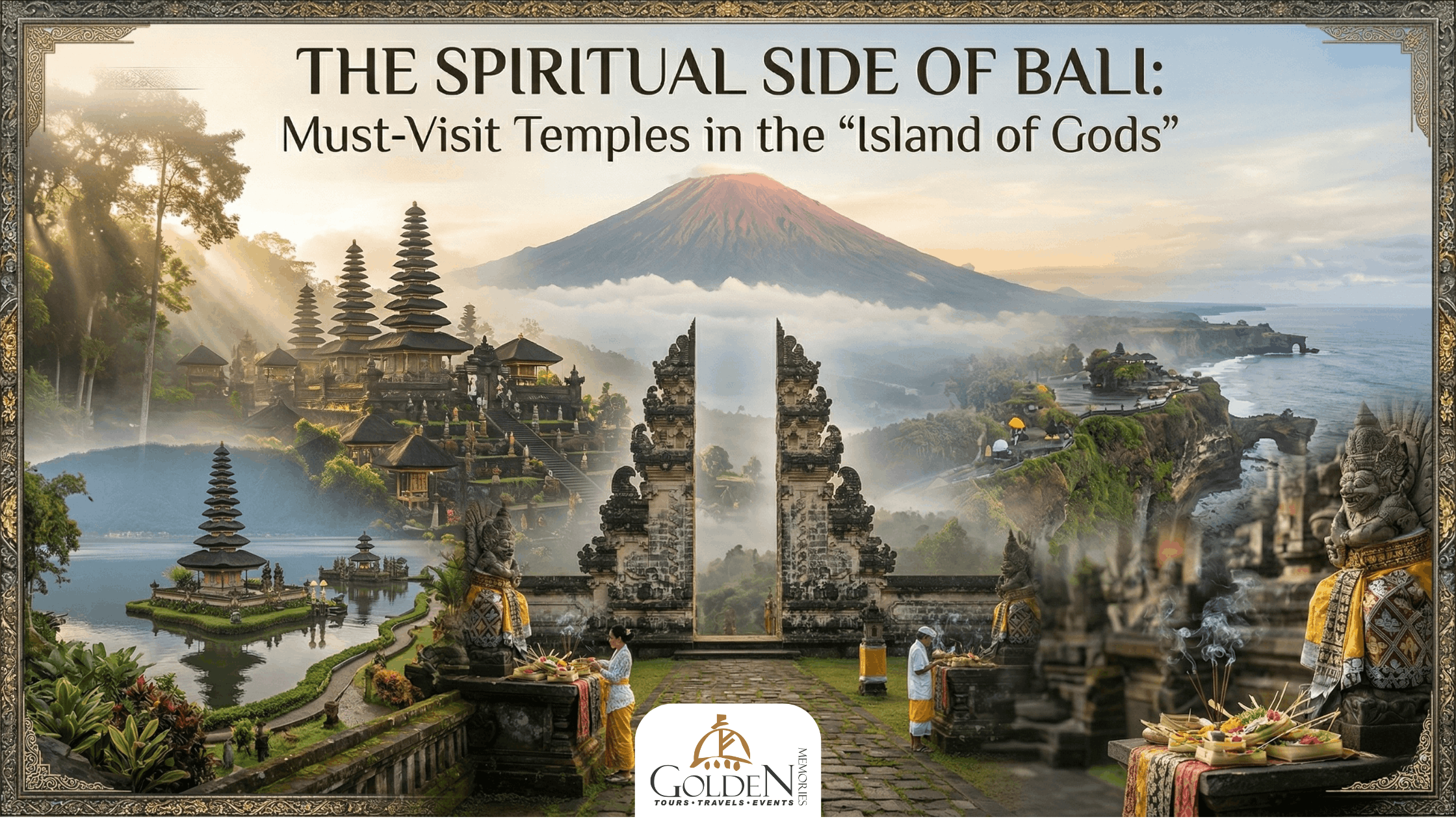
The Spiritual Side of Bali, Is a destination that transcends the typical tropical holiday. While its beaches are legendary, the true soul of the island resides in its “Puras”—the thousands of ornate Hindu temples that punctuate its emerald landscapes. Known as the “Island of the Gods,” Bali offers a spiritual resonance that feels deeply familiar to Indian travelers, yet uniquely Balinese in its execution.
In 2026, spiritual tourism has evolved. Visitors are no longer just looking for a photo in a gateway; they are seeking a connection to the ancient rhythms of Balinese Hinduism. Whether you are embarking on our Adorable Bali and Singapore City Combo Package or planning a dedicated pilgrimage, understanding the spiritual map of Bali is essential. Here is your guide to the most sacred sites on the island.
Besakih Temple: The Mother Temple
Perched 1,000 meters up the slopes of Mount Agung, Pura Besakih is the largest and holiest temple complex in Bali. For over a thousand years, it has stood as the spiritual center of the island.
- The Layout: It is an expansive complex of 23 separate but related temples. The most important is Pura Penataran Agung, built on seven ascending terraces.
- The Trinity: Much like in India, the temples are dedicated to the Hindu trinity—Shiva (the destroyer), Vishnu (the preserver), and Brahma (the creator).
- 2026 Insight: To manage the growing number of spiritual seekers, Besakih now utilizes a digital ticketing system that includes a mandatory local guide to explain the complex’s deep history.
Tanah Lot: Serenity by the Sea
Perhaps the most photographed temple in the world, Tanah Lot sits atop a jagged offshore rock, surrounded by the crashing waves of the Indian Ocean.
- The Legend: It was established in the 16th century by the priest Dang Hyang Nirartha. It is said that poisonous sea snakes guard the base of the island to protect it from evil spirits.
- The Ritual: At low tide, visitors can walk across to the base of the rock to receive a blessing with holy spring water and grains of rice on the forehead.
- The View: For travelers on a Jaipur private full-day sightseeing tour style itinerary, the sunset here is a mandatory stop—the silhouette of the temple against the orange sky is a sight that rivals the view from Nahargarh Fort.
Uluwatu Temple: The Clifftop Sentinel
Located on the southwestern tip of the island, Pura Luhur Uluwatu is perched on a sheer cliff dropping 70 meters into the sea.
- The Spiritual Gateway: It is one of the six key temples believed to be Bali’s spiritual pillars.
- Kecak Fire Dance: Every evening, the temple’s amphitheater hosts the Kecak dance, a rhythmic performance depicting the Ramayana. Watching the story of Rama and Sita unfold as the sun sinks into the ocean is a highlight of any jaipur tour package for couple.
Tirta Empul: The Holy Springs of Purification
If you seek a “hands-on” spiritual experience, Tirta Empul is the destination. This 10th-century temple is built around a bubbling holy spring.
- The Melukat Ritual: Both locals and tourists are invited to participate in the purification ritual. You enter the pools and bow under a series of carved waterspouts to cleanse your soul and mind.
- Etiquette: In 2026, the temple has introduced “Cultural Briefing Zones” where the ritual is explained in several languages, including Hindi, to ensure respectful participation.
Lempuyang Temple: The Gates of Heaven
While famous for the “Gates of Heaven” photo, Pura Lempuyang Luhur is one of Bali’s oldest and most highly regarded temples.
- The Climb: Reaching the highest temple requires a climb of over 1,700 steps. It is a true physical and spiritual test.
- The View: On a clear day, the gates perfectly frame the massive Mount Agung volcano, creating a visual representation of the bridge between the human and divine worlds.
Pura Taman Saraswati: The Temple of Wisdom
Located in the heart of Ubud, this temple is dedicated to Goddess Saraswati, the deity of knowledge and arts.
- The Lotus Pond: The entry is a spectacular walkway flanked by thousands of blooming pink lotus flowers.
- The Connection: For Indian travelers on an Indonesia tour package, this temple feels like a homecoming, celebrating the same reverence for wisdom and creativity found in Indian traditions.
✨ Why The Golden Memories is Your Spiritual Guide
At The Golden Memories, we believe that visiting a temple is about more than just the architecture—it’s about the energy. We bring the same attention to detail to Bali that we provide for our jaipur local sightseeing package.
- ✅ Verified Local Naturalists: Our guides are practicing Hindus who can explain the subtle differences and beautiful similarities between Balinese and Indian traditions.
- ✅ Bespoke Itineraries: We balance your 1 day jaipur trip style efficiency with the “Slow Travel” needed to truly feel the spirituality of Ubud’s hidden shrines.
- ✅ Seamless Logistics: From providing the mandatory sarong and sash to handling the 2026 Tourist Behavior Card requirements, we ensure your focus remains on the divine.
👉 Explore the Adorable Bali and Singapore City Combo Package!
Essential Temple Etiquette (2026 Update)
To ensure a respectful visit, every traveler must follow the “Tri Hita Karana” (the Balinese philosophy of harmony):
- Dress Modestly: You must wear a sarong and sash. Shoulders should be covered. Lightweight Indian ethnic wear like kurtis or long skirts is perfectly appropriate and comfortable.
- The “Period” Rule: Traditionally, women who are menstruating are asked not to enter the inner sanctums of the temples. This is rooted in ancient concepts of ritual purity.
- Mind Your Feet: Never point your feet toward an altar or a priest. When sitting, tuck your legs to the side or underneath you.
- Don’t Step on Offerings: Be careful not to step on the Canang Sari (flower offerings) placed on the ground; they are direct communications with the gods.
Frequently Asked Questions (FAQs)
1. Do Indian citizens need a visa for Bali in 2026?
Yes, you can get a Visa on Arrival (VoA) or apply for an e-VoA online before you travel.
2. What is the Bali Tourist Levy?
It is a mandatory fee of IDR 150,000 (approx. ₹850) per person, used for cultural and environmental preservation.
3. Are Balinese temples different from Indian temples?
While the deities (Shiva, Vishnu, Brahma) are the same, the architecture is distinctively Balinese, featuring “Meru” (multi-tiered thatched roofs) and split gateways (Candi Bentar).
4. Can I participate in the purification at Tirta Empul?
Yes, it is open to everyone regardless of religion, provided you follow the ritual rules and wear the proper green sash provided.
5. What is the best time to visit temples?
Early morning (6:00 AM – 8:00 AM) is best to avoid heat and crowds and to witness local morning prayers.
6. Is photography allowed inside temples? In the courtyards, yes. In the inner “holiest” sanctums, it is often restricted. Always look for signs or ask your guide.
7. What should I wear?
A sarong and sash are mandatory. If you don’t have one, The Golden Memories ensures our tours provide them, or you can rent them at the entrance.
8. Is it safe to travel to Bali in 2026?
Yes, Bali remains one of the safest and most welcoming tourist destinations in the world.
9. Can I visit a temple on a jaipur tour package for family for 3 days extension?
Yes! We can easily add a 3-day spiritual circuit to any larger package.
10. How many temples are in Bali?
It is estimated there are over 20,000 temples across the island.
11. What is “Nyepi”?
On March 29, 2026, Bali observes Nyepi (Day of Silence). Everything, including the airport, closes. No one is allowed outside. It is a beautiful day for meditation.
12. Is Indian food available near temples?
Yes, especially in Ubud and Kuta, there are many excellent Indian restaurants.
13. Are there monkeys at the temples?
Yes, particularly at Uluwatu and Besakih. Keep your sunglasses and hats secure!
14. How long is the flight from Jaipur to Bali?
Typically 10-12 hours including a layover in Delhi, Singapore, or Kuala Lumpur.
15. Can I use UPI in Bali?
While expanding, cash (IDR) and credit cards are still the most reliable. Singapore (part of our combo) accepts UPI widely.
16. What is a “Pura”?
“Pura” is the Balinese word for temple, derived from the Sanskrit word for “walled city” or “palace.”
17. Can I see a traditional dance at every temple?
No, but major ones like Uluwatu and Saraswati host regular performances.
18. Is travel insurance mandatory?
It is highly recommended for all international travel with The Golden Memories.
19. What is the “Mother Temple”?
Pura Besakih, so named because it is the most important and central temple for all Balinese Hindus.
20. Why book with The Golden Memories?
We offer the trust of a local Jaipur agency with the expertise of a global travel partner, ensuring your spiritual journey is respectful and seamless.
Conclusion
To visit the temples of Bali is to witness a culture where the divine is not distant, but a part of every breath and every flower offering. It is a spiritual journey that complements the heritage of India while offering a fresh, island perspective on devotion.
When you book your Adorable Bali and Singapore City Combo Package with The Golden Memories, you aren’t just seeing sites—you are participating in a living tradition. Let the “Island of the Gods” reset your spirit and the “Lion City” ignite your imagination.
Disclaimer:
The Golden Memories acts as a travel facilitator. Temple entry is subject to local religious ceremonies and government regulations. We recommend travelers check the 2026 lunar calendar for major festivals like Galungan and Kuningan, as some temple areas may be restricted during peak rituals.
Ready for a Soulful Reset?
Experience the harmony of the divine.

Comment (0)